
PROJECT NAME
Supporting the increased capacity and competence building of the EU medicines regulatory network (IncreaseNET)
SUMMARY
Regulatory assessors are increasingly challenged on one side by the significant increase of workload, while in parallel there is a rapid evolution of scientific developments across a wide range of areas for which appropriate expertise and relevant frameworks are not currently available in the network of EU medicines regulatory agencies. Additionally, the lack of work-sharing, co-working and network collaboration prevents efficient use of current resources and expertise.
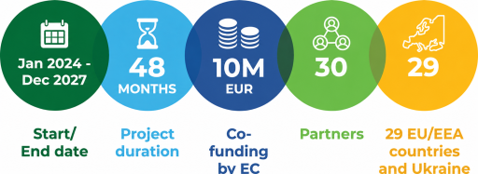
To address this, the proposed joint action of 30 partners (out of these, 29 are regulatory national competent authorities) aims to close the identified gaps in required capacity, competences, and frameworks in European Medicines Regulatory Network (EMRN) by an array of activities.
Firstly, the JA aims to developing learning curricula and training packages for regulatory assessors in the areas of most pressing needs in close collaboration with EU-NTC. To appropriately identify most pressing needs, mapping of the content of EU-NTC and of training materials available at NCAs will be performed. Additionally, to achieve best results with training, optimal methodologies for education of assessors will be developed.
Secondly, the JA will, as the main effort, establish an on-the-job training program, which will support learning and coaching activities. It will focus on newly hired assessors or assessors wishing to expand their expertise through reviewing assessment reports of ongoing CP and SA procedures and by supporting the exchange of expertise between senior and junior assessors. This is the main focus of the JA as it provides a framework for increasing both capacities and competence needed to support regulatory procedures. Furthermore, it enables NCAs to develop capacities to face the challenges represented by upcoming scientific developments. In this light, the JA will also identify best practices and MS’s strategies for recruitment and onboarding of clinical assessors.
With the aim to improve the capacities of the EMRN this JA will also promote efficient use of resources. To achieve this, it will encourage identification and exchange of knowledge capacity to support better and long-lasting collaboration between NCAs. Based on identified capacities and expertise, current areas of cooperation, and best practices regarding the use of external experts and academia in NCAs, the JA will perform mapping of competences of NCAs and establish and implement the process for combining NCAs into MNATs. To further focus on efficient use of resources, the JA will also provide recommendations on optimisation of processes in EMRN, possibilities for work-sharing, co-working and avoiding duplications (e.g., expansion of MNATs to DCPs and work sharing of assessment of bioequivalence studies) in collaboration with CMDh. Additionally, as Artificial Intelligence is developing quickly and profoundly influences the assessment of medicines, this JA will focus also on this field. It will try to increase readiness and uptake of these technologies in the regulatory Network.
Emphasis of the JA will also be placed on providing the NCAs with a framework to support and address innovation, new technologies and new scientific developments by identifying areas of expertise where active collaboration between NCAs and Academia is considered beneficial, by preparing an interaction toolkit between NCAs and innovators, by further developing the concept of Pre-Grant Regulatory Scientific Advice (PGRSA) and by encouraging sharing of information amongst NCAs. To support NCAs in making the necessary steps to promote innovations and address its challenges, it will also collect best practices in this field and perform an impact assessment of innovative technologies on NCAs.
Finally, to prevent duplication of work and to ensure sustainability of the project deliverables, all activities will be carried out in close collaboration with key EMA’s and HMA’s groups, so the impact of this JA will complement existing similar actions organised by the EU NTC, EU-IN, ACT EU, CHMP, CMDh and NDSG.
DURATION OF THE PROJECT
1.1.2024 – 31.12.2027
BUDGET
EUR 10 million
EC co-financing EUR 7.99 million (80%)
PARTNERS
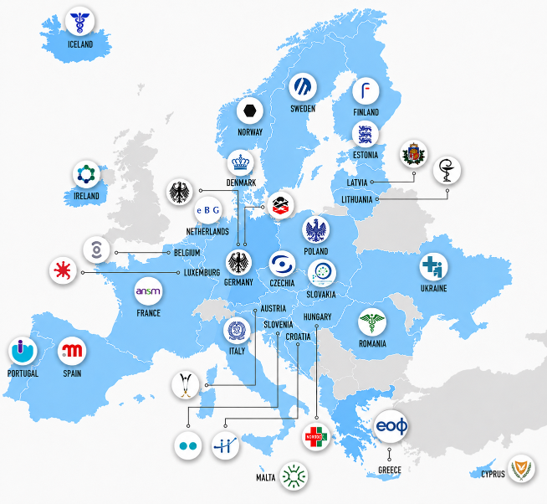
30 partners from 28 EU/EEA member states and Ukraine
Coordinator: JAZMP (Slovenia)
Partners:
AGES (Austria), FAMHP (Belgium), HALMED (Croatia), MOH CY-PHS (Cyprus), SÚKL (Czech Republic), DKMA (Denmark), SAM (Estonia), FIMEA (Finland), ANSM (France), BfArM (Germany), NNGYK (Hungary), HPRA (Ireland), AIFA (Italy), SMCA (Lithuania), MMA (Malta), CBG-MEB (Netherlands), NOMA (Norway), MUL (Poland), INFARMED (Portugal), NAMMDR (Romania), SUKL (Slovakia), AEMPS (Spain), MPA (Sweden), SECMOH (Ukraine), PEI (Germany), IMA (Iceland), SAM (Latvia), DISA (Luxembourg), EOF (Greece)
STAKEHOLDERS AND RELATED SITES
European Medicines Regulatory Network (EMRN)
European Medicines Agency (EMA)
Heads of Medicines Agencies (HMA)
European Commission (EC)
EU4Health programme 2021-2027 (EU4Health)
European Health and Digital Executive Agency (HaDEA)
EU Network Training Centre (EU NTC)
Committee for Medicinal Products for Human Use (CHMP)
Co-ordination group for Mutual recognition and Decentralised procedures – human (CMDh)
EU Innovation Network (EU-IN)
Committee for Advanced Therapies (CAT)
Biologics Working Party (BWP)
Accelerating Clinical Trials in the EU (ACT EU)
Network Data Steering Group (NDSG)
ROLE OF JAZMP
JAZMP will act as a project coordinator, making sure that the project follows the proposed work plan as well as timelines.
COORDINATOR CONTACT
Detailed information are available on the following LEAFLET.
Follow the project on  .
.


Funded by the European Union. Views and opinions expressed are however those of the author(s) only and do not necessarily reflect those of the European Union or European Health and Digital Executive Agency (HaDEA). Neither the European Union nor HaDEA can be held responsible for them.
